 Ammonium Chloride Manufacturer
When purchasing ammonium chloride, one of the most common questions buyers face is surprisingly simple: why can the price of ammonium chloride vary by hundreds or even thousands of dollars per metric ton?
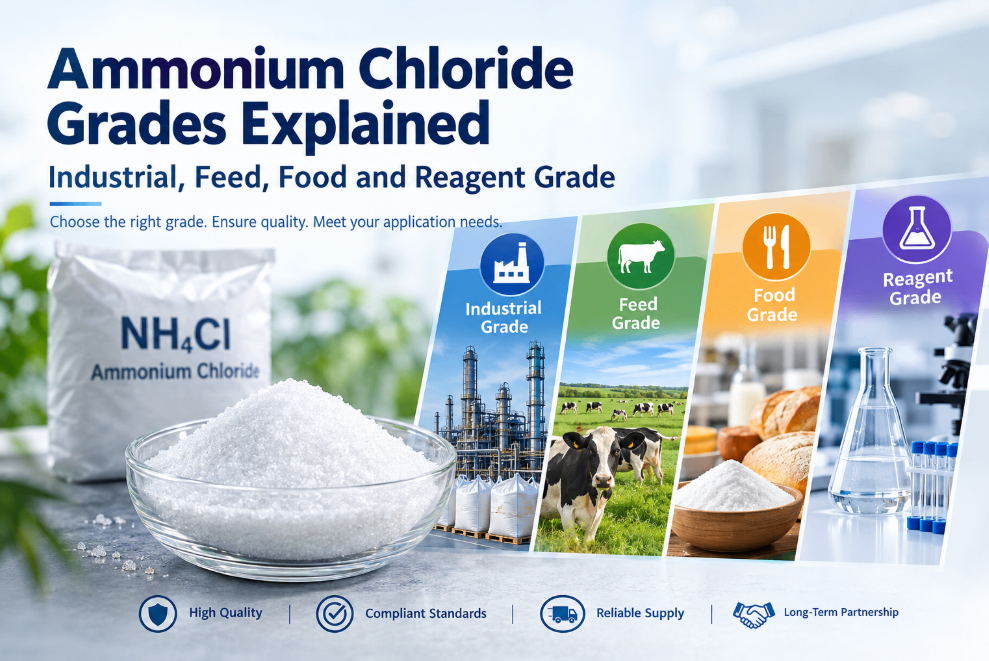
Some ammonium chloride is used for fertilizer production, some goes into animal feed, some is used in food processing, and some is purchased by laboratories for analytical work.
The chemical name is the same, and the chemical formula is the same—NH₄Cl. However, the purity, impurity profile, testing requirements, manufacturing controls, regulatory requirements, and suitable applications can be very different.
That is why professional buyers should not select ammonium chloride based only on a number such as 99% or 99.5%.
Choosing the right grade is more important than simply choosing the highest purity.
What Are the Main Grades of Ammonium Chloride?
For commercial purchasing, ammonium chloride is commonly categorized according to its intended application and quality requirements.
Industrial-grade ammonium chloride is primarily used in industrial manufacturing and chemical processes.
Feed-grade ammonium chloride is intended for permitted animal-feed applications and must meet the relevant feed requirements.
Food-grade ammonium chloride is intended for food-related applications where the applicable food-additive requirements must be met.
Reagent-grade ammonium chloride, including products designated as AR in some markets, is designed for laboratory analysis, research, and other applications requiring controlled impurity levels.
These grades should not be viewed simply as a ladder from low purity to high purity.
The actual difference can involve assay, moisture, water-insoluble matter, heavy metals, arsenic, lead, other trace impurities, testing methods, batch consistency, production controls, packaging, traceability, and regulatory compliance.
Industrial-Grade Ammonium Chloride
Industrial-grade ammonium chloride is mainly used as a raw material or process chemical in industrial manufacturing.
Typical applications include fertilizer production, industrial additives, metal treatment, battery-related materials, textile processing, chemical manufacturing, welding applications, and other industrial processes.
For industrial applications that do not require food, feed, or analytical specifications, industrial-grade ammonium chloride can provide a practical balance between product quality and cost.
What Should Buyers Check for Industrial-Grade Ammonium Chloride?
Industrial buyers should normally compare ammonium chloride content, moisture, water-insoluble matter, particle size, appearance, packaging, batch consistency, supply capacity, transportation costs, and overall price.
For a standard industrial process, there is usually little economic justification for purchasing a much more expensive reagent-grade product if the additional specifications do not provide any practical benefit.
The most cost-effective product is not necessarily the highest-purity product. It is the product that meets the actual requirements of the application.
Feed-Grade Ammonium Chloride
When ammonium chloride is intended for animal feed, the purchasing requirements become significantly different.
Feed-grade ammonium chloride can be used in permitted animal nutrition applications, including as a source of non-protein nitrogen in ruminant diets.
Potential applications include cattle, dairy cattle, sheep, goats, and other ruminants, subject to the applicable formulation and regulatory requirements.
The key question is not simply whether the product has an assay of 99% or higher.
The more important question is whether the product meets the applicable feed-additive requirements for its intended use.
Buyers should pay particular attention to relevant contaminant specifications, including arsenic, lead, cadmium, chromium, and other parameters required by the applicable standard.
Industrial-grade and feed-grade ammonium chloride should therefore not be treated as interchangeable simply because both products have the same chemical formula.
What Documents Should Feed Buyers Request?
Feed manufacturers should request a product specification, batch-specific COA, arsenic test results, relevant heavy-metal test results, moisture, ammonium chloride content, batch information, production date, and applicable feed-additive compliance documentation.
For long-term procurement, buyers should also evaluate batch-to-batch consistency rather than relying on a single laboratory report.
Food-Grade Ammonium Chloride
If ammonium chloride will enter a food production process, it should not be purchased simply as ordinary industrial-grade ammonium chloride.
Food-grade ammonium chloride must meet the applicable food-additive requirements for the specific intended use and target market.
Potential food-related applications may include certain food-processing operations, yeast production, fermentation processes, baking-related applications, and other permitted uses.
One common purchasing misconception is:
“If ammonium chloride is 99.5% pure, it is automatically food grade.”
This is not necessarily correct.
Food-grade suitability cannot be established by assay alone.
Buyers may also need to evaluate impurity limits, heavy metals, arsenic, lead, water-insoluble matter, analytical methods, manufacturing controls, labeling requirements, applicable food-additive standards, and destination-market regulations.
If the product will be used in food production, buyers should clearly communicate the intended food application to the supplier and request documentation demonstrating compliance with the applicable requirements.
Reagent-Grade Ammonium Chloride
Reagent-grade ammonium chloride is commonly used in laboratories, research facilities, analytical testing, and chemical synthesis.
Typical applications include chemical analysis, laboratory testing, research experiments, solution preparation, analytical chemistry, and selected chemical synthesis processes.
For reagent-grade products, purity is important, but it is not the only consideration.
The identity and concentration of individual impurities can have a significant impact on analytical results.
For example, a product labeled NH₄Cl ≥99.8% may appear highly pure. However, if an analytical procedure is sensitive to iron, sulfate, heavy metals, or other trace impurities, the assay value alone does not provide enough information.
What Should Laboratory Buyers Check?
Laboratory buyers should review assay, moisture, water-insoluble matter, sulfate, iron, heavy metals, other specified impurities, analytical methods, and batch-to-batch consistency.
The value of reagent-grade ammonium chloride is not simply its higher assay. Controlled trace impurities and consistent analytical performance can be equally important.
Industrial vs Feed vs Food vs Reagent Grade Ammonium Chloride
| Factor | Industrial Grade | Feed Grade | Food Grade | Reagent Grade |
|---|---|---|---|---|
| Primary application | Industrial manufacturing | Animal feed | Food production | Laboratory and research |
| Assay requirements | Application dependent | Applicable feed requirements | Applicable food requirements | Analytical-grade requirements |
| Heavy-metal control | Application dependent | Strictly controlled according to applicable requirements | Strictly controlled according to applicable requirements | Typically stringent |
| Arsenic and other contaminants | Application dependent | Important | Important | Important |
| Batch consistency | Important | Very important | Very important | Critical |
| Food use | Not intended | Not intended | Applicable uses only | Not automatically food grade |
| Feed use | Should not be assumed suitable | Applicable uses only | Not automatically feed grade | Not automatically feed grade |
| Laboratory analysis | Generally unsuitable | Unsuitable | Unsuitable | Suitable for applicable analytical uses |
| Key purchasing factor | Cost efficiency and supply stability | Safety, quality, and compliance | Food standards and documentation | Purity, trace impurities, and consistency |
The key takeaway is that grade does not simply mean purity.
A product with a 99.8% assay should not automatically be considered food grade or feed grade simply because its assay is higher than that of another product.
Which Ammonium Chloride Grade Should You Choose?
Ammonium Chloride for Industrial Production
If ammonium chloride is used in general industrial production, and the process does not impose additional purity or impurity requirements, the industrial grade is usually the most cost-effective specification.
Key purchasing factors include assay, moisture, particle size, water-insoluble matter, price, and supply capacity.
Ammonium Chloride for Cattle and Sheep Feed
For ruminant feed applications, buyers should prioritize ammonium chloride that meets the applicable feed-additive requirements.
Key considerations include feed compliance, arsenic, heavy metals, batch-specific COA, traceability, and consistent supply.
If a supplier recommends industrial-grade ammonium chloride as a lower-cost alternative, the buyer should first verify whether the product actually meets the requirements for the intended feed application.
Ammonium Chloride for Food Production
For food-processing applications, buyers should select a product that meets the applicable food-additive requirements for the specific use.
Key considerations include the applicable food standard, impurity limits, analytical reports, manufacturing controls, and regulatory documentation.
For international trade, the requirements of the destination country or region should also be reviewed. Compliance in one market does not automatically establish compliance in every other market.
Ammonium Chloride for Laboratory Analysis
For laboratory and research applications, buyers should generally select the appropriate reagent or analytical grade.
Key considerations include assay, trace impurities, analytical methods, specification limits, and batch-to-batch consistency.
What Is Coated or Controlled-Release Ammonium Chloride?
In animal nutrition, some suppliers offer coated or controlled-release ammonium chloride.
Conventional ammonium chloride dissolves relatively quickly when it comes into contact with liquid. A coated product uses an external coating to modify the release behavior of the ammonium chloride.
In simple terms:
Conventional ammonium chloride: faster release.
Coated ammonium chloride: controlled release.
The concept is to create a more controlled release profile that may better align nitrogen availability with microbial utilization in the rumen.
However, buyers should not assume that the word “controlled-release” automatically means better animal performance.
When evaluating such products, buyers should request information about the coating material, coating rate, release profile, product stability, feeding trials, target animal species, and recommended inclusion rate.
If a supplier claims that a coated product improves daily weight gain, feed conversion, or overall feed economics, supporting trial data should be requested whenever possible.
Three Common Mistakes When Buying Ammonium Chloride
Buying Based Only on Price
This is one of the most common procurement mistakes.
One supplier may offer a low-priced industrial-grade product while another supplier quotes a higher price for feed-grade material.
If the buyer compares only the price per metric ton, the second supplier may appear unnecessarily expensive.
However, if the product is going into animal feed, the two products may not be equivalent from a specification or compliance perspective.
The correct approach is to determine the application first, select the appropriate grade second, and compare prices only after the specifications are aligned.
Comparing Only the 99% Assay Number
This is another common mistake in chemical procurement.
Two suppliers may both specify NH₄Cl ≥99%, while their moisture, water-insoluble matter, sulfate, iron, heavy metals, arsenic, lead, and other impurity specifications may differ.
Professional procurement should therefore compare the complete specification and actual batch COA rather than focusing on a single purity number.
A difference of 0.1% in assay does not necessarily tell you which product is better for your application.
Ignoring Long-Term Batch Consistency
A single batch that passes inspection does not necessarily prove that a supplier can maintain consistent quality over the long term.
Long-term buyers should evaluate multiple batches and examine production stability, sample retention, batch traceability, COA management, and the supplier's quality-control procedures.
For large manufacturers and international buyers, consistent quality across multiple shipments can be more valuable than an impressive result from a single batch.
What Documents Should You Request From an Ammonium Chloride Supplier?
Product Specification
First, confirm exactly what grade the supplier is offering.
A specification sheet should clearly identify the product name, chemical formula, CAS number, grade, assay, key impurity limits, appearance, packaging, storage conditions, and applicable test methods.
Batch-Specific COA
A COA, or Certificate of Analysis, is one of the most important documents when purchasing ammonium chloride.
Buyers should distinguish between typical values shown on a marketing specification and actual test results for a specific production batch.
Whenever possible, the COA should be traceable to the batch being shipped.
Depending on the application, buyers should review assay, moisture, water-insoluble matter, heavy metals, arsenic, lead, and other critical parameters.
Safety Data Sheet
For international trade and industrial chemical procurement, buyers should request an SDS and other relevant safety or transportation documentation when required.
For export orders, documentation should be prepared well before shipment rather than after the cargo is ready to leave the factory.
Regulatory and Compliance Documentation
For food, feed, and international-market applications, buyers should identify the documentation required for the specific product, intended use, and destination market.
Depending on the transaction, this may include food-related compliance documents, feed-additive documentation, quality-management certificates, third-party laboratory reports, export documentation, and destination-market regulatory information.
A certificate or document issued for one purpose or market should not automatically be interpreted as proof of compliance for every other application or country.
How to Choose a Reliable Ammonium Chloride Supplier
Product Quality
Do not ask only, “What is the purity?” Request the complete specification and actual test data.
Batch Consistency
Review several consecutive COAs whenever possible. Multiple batches provide a much better indication of long-term quality consistency than a single report.
Production Capacity
Determine whether the supplier is a manufacturer or a trading company, and evaluate its ability to support your expected purchasing volume.
For larger orders, ask about annual production capacity, monthly supply capability, available inventory, peak-season availability, and typical lead time.
Packaging Capability
Depending on transportation and storage conditions, ammonium chloride may be supplied in 25 kg bags, 50 kg bags, jumbo bags, or customized packaging.
Export buyers should also consider container loading efficiency and packaging durability during international transportation.
Export Experience
If the product will be exported, experience with international chemical shipments can be an important supplier-selection factor.
Buyers should confirm whether the supplier can support documents such as COA, SDS, packing list, commercial invoice, certificate of origin, and other documents required by the customer or destination market.
Why Can Ammonium Chloride Prices Vary So Much?
When market quotations vary significantly, buyers should not immediately assume that the higher-priced supplier has an excessive margin, nor should they assume that the lowest quotation represents the best value.
Price differences can result from product grade, raw-material source, manufacturing process, impurity control, packaging, testing costs, inventory position, order volume, transportation distance, tax treatment, freight costs, export documentation, and payment terms.
For a meaningful comparison, procurement conditions should be standardized as much as possible.
Same grade + same specification + same packaging + same quantity + same delivery location + same trade terms
Only after these conditions are aligned can supplier quotations be compared fairly.
Ammonium Chloride Grade Selection Guide
| Intended Application | Recommended Grade | Key Factors to Check |
|---|---|---|
| Fertilizer and general industrial manufacturing | Industrial grade | Assay, moisture, particle size, water-insoluble matter, price, supply capacity |
| Cattle, sheep, and other ruminant feed applications | Feed grade | Feed compliance, arsenic, heavy metals, COA, batch consistency |
| Food processing | Food grade | Applicable food standard, impurity limits, analytical reports, compliance documentation |
| Laboratory analysis and research | Reagent grade | Assay, trace impurities, analytical methods, batch consistency |
| Applications requiring controlled release in ruminant nutrition | Coated or controlled-release ammonium chloride | Coating rate, release profile, stability, feeding-trial data |
Choose the Right Grade, Not Simply the Most Expensive Product
The biggest mistake in ammonium chloride procurement is treating purity as the same thing as grade.
A professional purchasing process should follow a logical sequence:
Define the application → Identify the applicable standard → Select the grade → Compare the complete specification → Compare impurity limits → Review batch COA → Verify compliance documentation → Compare total purchasing cost
Industrial-grade, feed-grade, food-grade, and reagent-grade ammonium chloride are not simply four levels of purity. They are products designed for different applications and quality-control requirements.
Industrial applications usually focus on cost efficiency and reliable supply.
Feed applications focus on safety, contaminant control, and feed compliance.
Food applications focus on food standards, permitted uses, and regulatory documentation.
Laboratory applications focus on purity, trace impurities, analytical performance, and batch consistency.
The right purchasing question is therefore not:
“Which supplier offers the cheapest ammonium chloride?”
The better question is:
“Which ammonium chloride grade meets my application requirements and can be supplied consistently over the long term?”
That approach can help buyers reduce unnecessary costs, minimize quality risks, and maintain stable production.
If you are sourcing ammonium chloride, provide the supplier with your intended application, required quantity, target specification, packaging requirements, and destination market. Asking suppliers to quote against the same specification makes price comparisons much more meaningful.